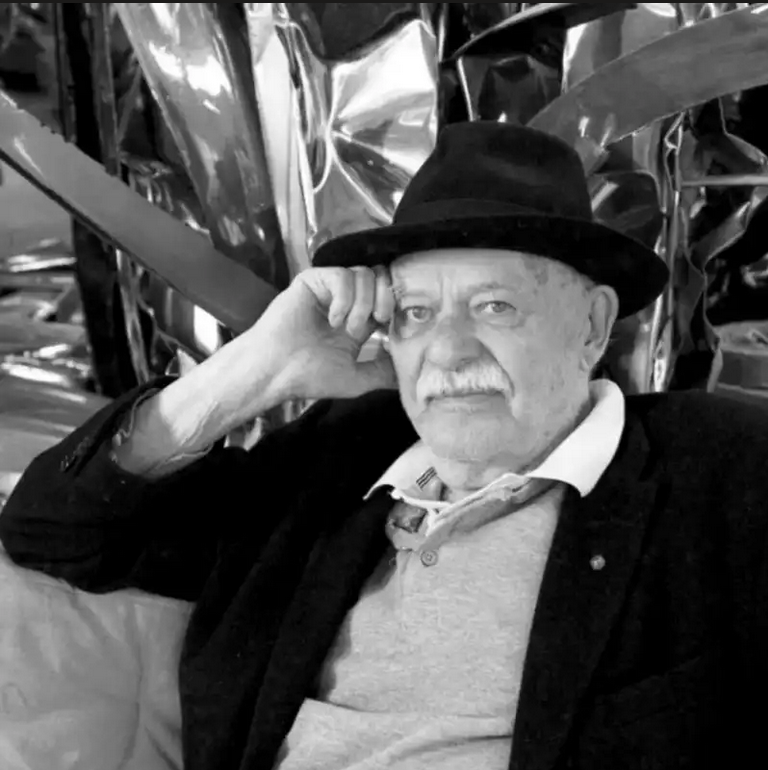

John Chamberlain (1927–2011) was one of the most influential American sculptors of the postwar period, renowned for transforming discarded automobile parts into dynamic abstract compositions. Emerging from the artistic milieu of New York in the late 1950s, Chamberlain developed a highly distinctive sculptural language that fused the gestural energy of Abstract Expressionism with the material directness of Assemblage and the industrial vernacular of postwar America.
After studying at the Art Institute of Chicago and Black Mountain College, Chamberlain began incorporating salvaged car components into his work, crushing, folding, and welding painted steel into complex structures that challenged conventional notions of volume, movement, and form. Although his sculptures are often associated with the automobile and American consumer culture, Chamberlain consistently emphasized the formal and expressive potential of his materials, treating metal as a medium capable of conveying rhythm, colour, and emotion.
Over the course of a career spanning more than five decades, Chamberlain worked across a wide range of media—including photography, film, painting, and foam sculpture—while continually returning to the sculptural innovations for which he became best known. His work has been the subject of major museum exhibitions worldwide, including retrospectives at the Solomon R. Guggenheim Museum, and is held in the collections of institutions such as the Museum of Modern Art, the Whitney Museum of American Art, the Tate, and the Stedelijk Museum Amsterdam. Today, Chamberlain is widely regarded as a pivotal figure in the development of contemporary sculpture, celebrated for his ability to transform industrial detritus into works of remarkable vitality and poetic force.